

SEO
For an operations leader at a Malaysian manufacturer or distributor, choosing between SAP Business One and Odoo is not simply a question of which product has more features. It is whether the system can control the path from demand and purchasing through production, inventory, delivery and finance without creating fragile workarounds. IT must be able to support the design, while finance must be able to trust the transactions and controls.
This comparison helps that buying group decide which platform deserves a detailed fit assessment. It covers operational depth, implementation model, customisation, governance, integration, Malaysian requirements and total-cost categories. It does not assume that either product is universally better.

The short answer
SAP Business One is usually the stronger shortlist candidate when the organisation wants a tightly defined ERP core around finance, purchasing, inventory, sales and established operational controls. It should still be tested against the exact production model, warehouse rules, reporting needs and required extensions.
Odoo is usually the stronger shortlist candidate when the organisation values a broad modular application suite and expects to configure or extend workflows around manufacturing, inventory, quality, maintenance, shop-floor work and other connected processes. That flexibility requires disciplined ownership so that custom changes do not become an uncontrolled maintenance burden.
The deciding factor is not company size alone. A better test is the complexity of the operating model: production methods, traceability, warehouse structure, legal entities, approval rules, integrations, exception volume and the organisation’s capacity to govern change.
Comparison at a glance
| Decision area | SAP Business One | Odoo | What to verify in a fit workshop |
|---|---|---|---|
| Core operating model | Integrated ERP core covering financials, purchasing, inventory, sales and reporting | Modular application suite spanning ERP and adjacent operational workflows | Which process crosses the most departments, and where do exceptions occur? |
| Manufacturing and distribution | Official product material positions it for light manufacturing and wholesale distribution | Official documentation covers manufacturing orders, work centres, shop floor, quality, maintenance, subcontracting and inventory flows | Demonstrate the buyer’s actual bill of materials, routing, replenishment, traceability and return scenarios |
| Customisation | Assess configuration, extensions and integrations as part of the proposed solution | Studio supports changes such as fields, views, models, rules, reports and approvals; custom modules are available under suitable hosting | Which changes are configuration, which are custom code, and who owns them after go-live? |
| Deployment | SAP states that cloud and on-premise options are available | Odoo documents Odoo Online, Odoo.sh and on-premise options, with different limits for non-standard applications | Who owns infrastructure, backups, monitoring, upgrades and recovery? |
| Multi-entity control | Validate the proposed database, company and reporting design against the group structure | Odoo supports companies and branches with access and reporting rules | Which records are shared, which are entity-specific, and how are intercompany transactions handled? |
| Malaysian requirements | Require a current, demonstrated localisation and statutory compliance design | Odoo 19 documentation lists Malaysian accounting, reporting, SST and MyInvois modules | Test current tax, e-invoice, credit-note and exception cases with finance before selection |
This table is a screening tool, not a product verdict. A capability shown on a vendor page is not proof that it fits the organisation’s configuration, controls or transaction volume.
Start with the operating model, not the software menu
Map one representative flow before scheduling product demonstrations. For a manufacturer, that could begin with a sales forecast or customer order and continue through material planning, purchasing, goods receipt, production, quality release, finished-goods storage, delivery and invoicing. For a distributor, it could cover replenishment, allocation, picking, packing, delivery, returns and supplier claims.
Record four things at every hand-off:
- Which role makes the decision?
- Which data must be complete and accurate?
- Which approval or control applies?
- What happens when the normal path fails?
This process map exposes the differences that matter. A product may handle the normal transaction well but require a workaround for partial completion, substitute materials, batch quarantine, customer-specific packing, landed cost, backorders or returns. Those exceptions often determine implementation effort and user acceptance.

Manufacturing and distribution depth
SAP’s current Business One material describes an integrated system for accounting, purchasing, inventory, sales, customer management, reporting and analytics. SAP also positions the product for light manufacturing and wholesale distribution. This makes it a credible candidate when the organisation wants core commercial and inventory transactions governed within one ERP structure.
Odoo presents manufacturing as a connected set of applications and functions. Its current documentation covers bills of materials, one- to three-step manufacturing, work centres, work-order dependencies, master production scheduling, subcontracting, lots and serial numbers, shop-floor activity, quality, maintenance and production analysis. Its inventory material also covers multiple warehouses, replenishment, routes, picking methods, cycle counting and traceability.
The longer feature list does not decide the winner. Ask both proposed solutions to run the same scenarios using representative items and transaction rules. At minimum, test:
- make-to-stock and make-to-order products;
- multi-level bills of materials and approved substitutions;
- rejected material, rework, scrap and production variance;
- lot or serial traceability from supplier to customer;
- transfers between warehouses or legal entities;
- partial receipt, partial production and partial delivery;
- customer returns and supplier returns; and
- month-end reconciliation between inventory movements and financial postings.
Score the result by process coverage, control strength, operator effort, exception handling and reporting clarity. Do not score only the quality of the demonstration.
Implementation model and accountability
Both products need implementation work. The practical difference is how responsibilities are divided among the software vendor, implementation partner, internal process owners and internal IT team.
For each shortlisted design, require a responsibility matrix covering requirements, process decisions, data cleansing, configuration, custom development, integration, security, testing, training, cutover, support and upgrades. A proposal that lists modules but does not assign these responsibilities leaves material cost and delivery risk unresolved.
The project should also define what “standard” means. A standard feature can still require extensive configuration, master-data preparation and user training. A custom feature may be justified when it protects an important operating rule, but it should have an owner, documentation, tests and an upgrade path.
Customisation, integration and governance
Odoo makes its customisation surface visible. Odoo Studio can add or change fields, views, models, automation rules, reports and approval rules without conventional coding. Odoo’s hosting documentation also makes an important boundary clear: Odoo Online is not compatible with non-standard applications, while Odoo.sh or on-premise deployment can support custom modules. The hosting choice therefore affects both capability and operating responsibility.
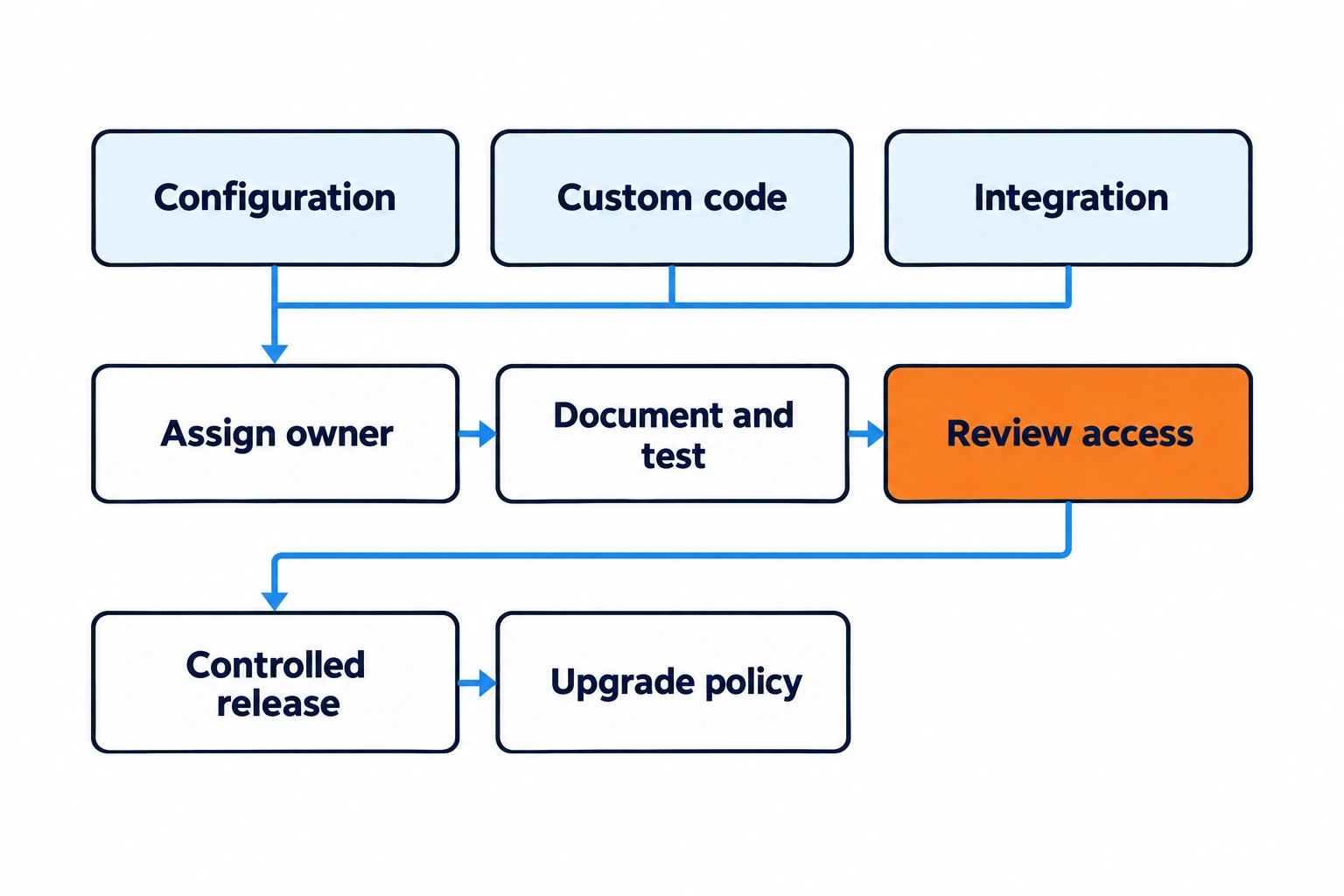
For SAP Business One, the shortlist should identify which requirements are covered by the core product, which depend on configuration, and which require extensions or external systems. The same discipline applies to Odoo. In both cases, every integration should specify:
- the owner of customer, supplier, item, price and inventory records;
- the direction and timing of each exchange;
- validation and approval rules;
- how failed transactions are detected, corrected and reconciled; and
- what continues to operate when an interface is unavailable.
Flexibility is valuable only when it remains supportable. A change register, release process, test environment, access-control review and upgrade policy should be part of the solution design rather than added after go-live.
Malaysian localisation must be demonstrated
Malaysian statutory requirements are a selection gate, not a checklist item to accept on description alone. Odoo’s version 19 documentation lists Malaysian modules for accounting, reports, UBL PINT, SST and MyInvois integration. That is useful evidence of available product support, but finance should still test the organisation’s actual tax and e-invoice cases in the proposed edition and configuration.
Apply the same requirement to SAP Business One. Ask the implementation team to demonstrate the current Malaysian localisation and any connected service using the organisation’s real document types. The test set should include sales and purchase invoices, debit or credit adjustments, exemptions, foreign customers, consolidated cases where relevant, cancellation and rejection handling, audit records and period-end reporting.
Record the product version, localisation component, responsible support party and update process. Regulations and platform capabilities change; a screenshot from an earlier release is not sufficient evidence for approval.
Compare total cost by category, not headline price
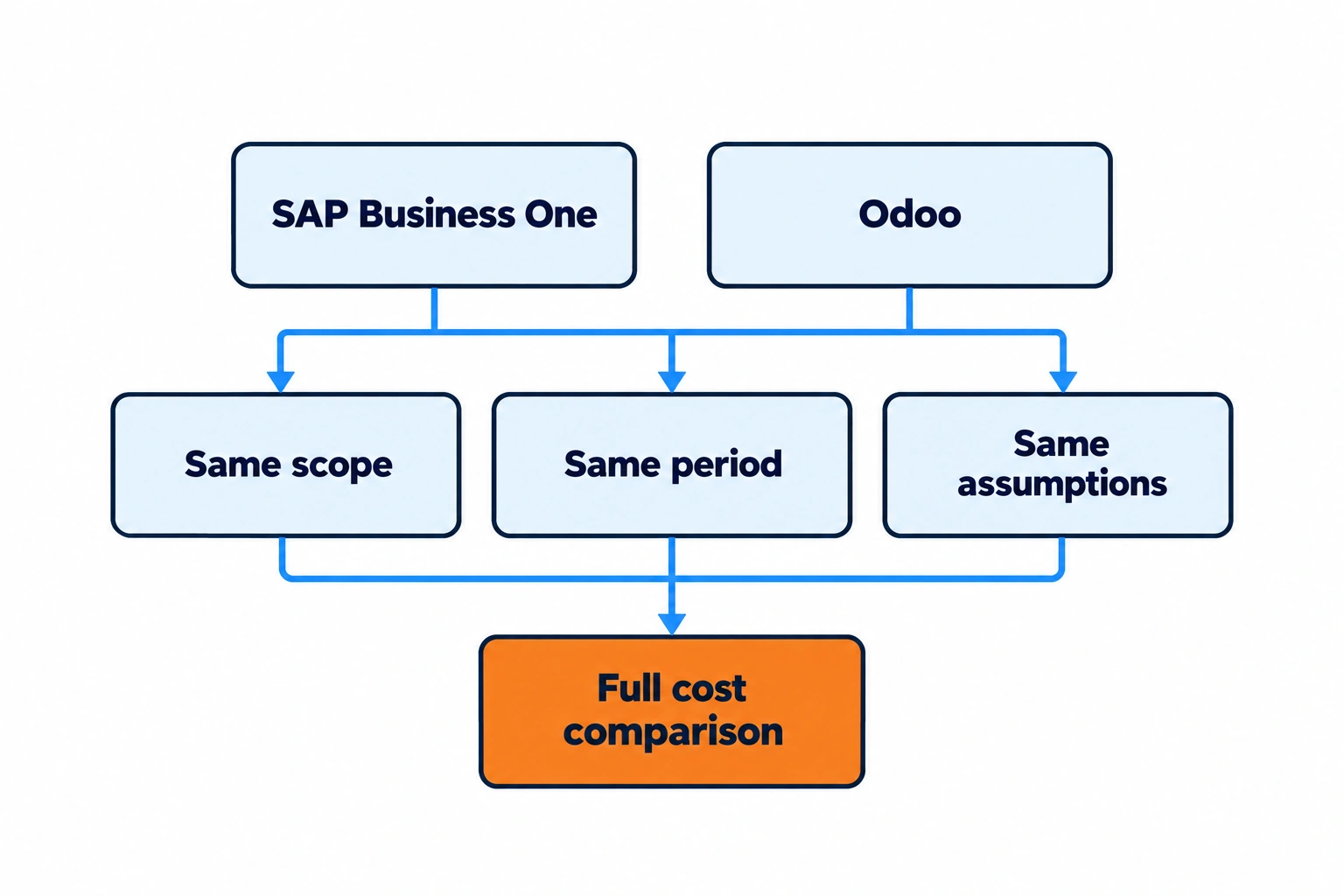
A defensible cost comparison covers the full evaluation period and uses the same scope for both options. Include:
- software subscription or licence;
- hosting and infrastructure;
- implementation and project management;
- data cleansing and migration;
- configuration and custom development;
- integrations and connected services;
- testing, training and change management;
- support, monitoring and administration;
- upgrades and regression testing; and
- internal staff time, contingency and retirement of old systems.
Odoo’s published plans distinguish between standard use and requirements such as Studio, multi-company operation, external APIs or custom development; Odoo.sh hosting and implementation services are separate considerations. SAP Business One pricing depends on the proposed commercial and deployment arrangement. Do not compare an Odoo subscription alone with a complete SAP implementation proposal, or vice versa.
Use a common five-year cost model if that matches the organisation’s planning horizon. Label all assumptions, exclude unapproved benefits, and show which costs vary with users, entities, transaction volume, custom scope or infrastructure.
Fit recommendation by operating context
Prioritise SAP Business One for deeper assessment when:
- the organisation wants an ERP-centred operating model with strong emphasis on financial, purchasing, inventory and sales control;
- the target process is relatively stable and the team prefers to limit bespoke workflow changes;
- light manufacturing or wholesale distribution scenarios fit the proposed standard design; and
- the implementation and support responsibilities are clear and acceptable.
Prioritise Odoo for deeper assessment when:
- manufacturing, warehouse and adjacent operational workflows need to be assembled from a broad modular suite;
- configuration flexibility is important and the organisation can govern it;
- shop-floor, quality, maintenance, subcontracting or other connected applications are material to the scope; and
- the team has made a deliberate hosting and custom-code decision.
Keep both on the shortlist when: the process is not yet defined well enough to expose the trade-offs. In that case, spend less time comparing feature lists and more time preparing a controlled scenario pack.
Before issuing a request for proposal, ask every stakeholder to approve the process boundary, critical exceptions, data owners, integration list, statutory test cases, deployment responsibilities and cost-model assumptions. That creates a common basis for a decision and reduces the risk of selecting the best presentation rather than the best operational fit.
NetDB’s ERP solution page outlines its ERP service area. For background on the Odoo platform, see Odoo: Open Source ERP and CRM. A vendor discussion should begin with the mapped process and evidence requirements described above.
Sources
- SAP Business One product overview — checked 19 October 2026.
- SAP Business One features — checked 19 October 2026.
- Odoo 19 Manufacturing documentation — checked 19 October 2026.
- Odoo Manufacturing product page — checked 19 October 2026.
- Odoo Inventory product page — checked 19 October 2026.
- Odoo Studio documentation — checked 19 October 2026.
- Odoo hosting documentation — checked 19 October 2026.
- Odoo companies and branches documentation — checked 19 October 2026.
- Odoo Malaysia localisation documentation — checked 19 October 2026.
- Odoo pricing plans — checked 19 October 2026; used for cost categories only, not quoted prices.
